Services


Servicios
X

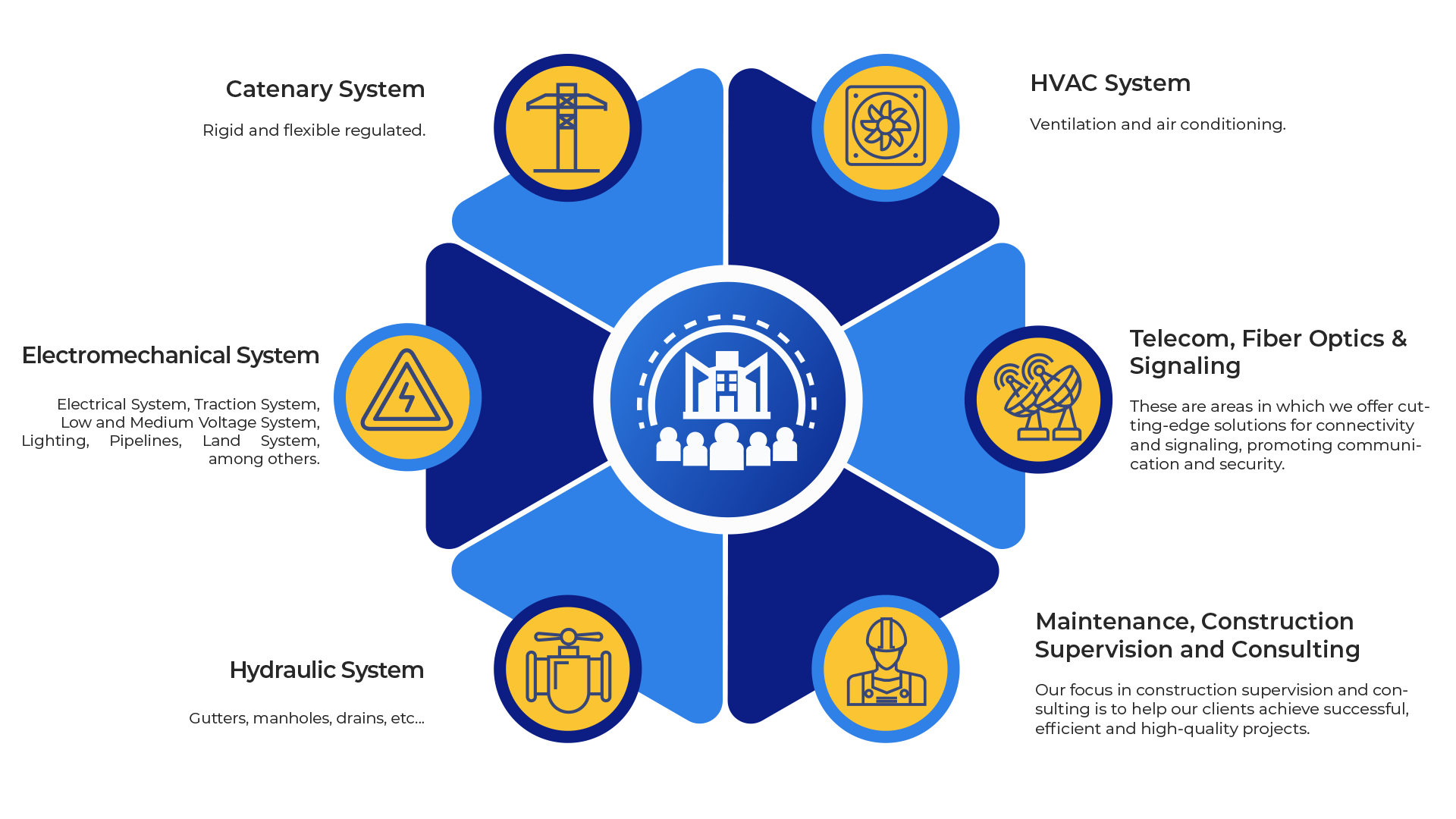
HVAC System

This system plays a fundamental role in air conditioning and comfort in buildings and other closed spaces.

Operation of an HVAC system:

• Ventilation: Ventilation is essential to maintain a constant supply of fresh air and to remove contaminants and odors from the interior spaces. HVAC systems include fans and ducts to distribute air.
• Air conditioning: Air conditioning is used to cool the air on hot days. Air conditioning systems can use compressors and refrigerants to extract heat from indoor air and release it outside.
• Ducts: Ducts are tubes that transport hot or cold air from the HVAC unit to the areas you want to air condition. Ducts can be made of metal or plastic and are found in walls, ceilings or floors.

In summary, an HVAC system is essential for providing a comfortable and healthy indoor environment by controlling temperature, humidity, and air quality. Proper choice of components and regular maintenance are essential to ensure efficient and long-lasting operation.

X

Telecom, Fiber Optic and Signaling

Telecom

Telecommunications encompass a wide range of technologies and services that enable long-distance communication and data transfer.

Telecom Services:

• Telephony: Includes landline and mobile telephony, which allows long-distance voice communication.

• Internet: Provides access to the World Wide Web and other online services through a variety of technologies, such as broadband and fiber optics.

•Television: Includes the transmission of television programs and multimedia content through terrestrial, cable or satellite signals.

• Data Networks: They allow the transfer of data between devices and systems, essential for business communication and the transmission of information on the Internet.

Telecom Technologies:

• Smart Cards: We offer preventive/corrective maintenance, supply of spare parts, supply of electronic cards and technical support of the components that make up a Smart or Prepaid Card System with highly qualified personnel with experience in the sector.

• Networks: : In Systems and IT (Telecommunication Networks, VOIP and IT Solutions) we carry out wiring installations, connection and TDR tests in networks for Intrinsic Safety Systems such as signaling in railway systems, remote control in electrification systems and control in fire systems. Voice and Data Networks, Radio Frequency Links. LAN, WAN and WiFi networks. We also supply national and imported materials, equipment and spare parts.

Fiber Optic

Fiber optics is a data transmission technology that uses thin threads of glass or plastic to transmit information in the form of pulses of light. It is widely used in telecommunications and data transmission due to its numerous advantages over other transmission media, such as copper cable.
Fiber optics work on the principle of total internal reflection. Light propagates through a central core of glass or plastic, and is surrounded by a coating layer that has a lower refractive index. This causes light to be internally reflected at the core-cladding interface and propagate along the fiber at very acute reflection angles.
We have highly qualified personnel and technology to carry out the design and laying of fiber optics and IT Systems (VolP). We provide installation, fusion and OTDR testing services for fiber optic cables for CCTV systems, radio frequency communications systems and network systems. conventional.

CCTV

A Closed Circuit Television (CCTV) is a video surveillance system used to monitor and record specific areas in real time. This system is made up of video cameras, monitors, transmission cables and storage devices.

• CCTV Cameras: They are the main component of the system. These cameras can be fixed or mobile, and are designed to capture images and videos of the areas under surveillance.

• Monitors: Cabling is essential for transmitting video signals from cameras to monitors and, in some cases, to recording devices. Different types of cables are used, such as coaxial, fiber optic or network cables.

• Wiring: They are the main component of the system. These cameras can be fixed or mobile, and are designed to capture images and videos of the areas under surveillance.

• Recording Devices: To store the images and videos captured by the cameras, recording devices such as DVRs (Digital Video Recorders) or NVRs (Network Recorders) are used. These devices allow playback of recordings and storage of data for a specific period.

• Data Storage: CCTV systems typically use hard drives to store recordings. Storage capacity varies depending on system needs and can range from a few hours to several months.
X

Maintenance, Work Supervision and Consulting.

1. Maintenance:

Taking care of your facilities and keeping them in perfect condition is essential for the efficient functioning of your business. At IMA we offer professional maintenance services that cover:
• Preventive Maintenance: We implement preventive programs to avoid problems before they occur, reducing costs and downtime.
• Corrective maintenance: We respond quickly to unforeseen needs, providing effective solutions to minimize any disruption to your operations.
• Predictive Maintenance: We use advanced technology to predict potential failures, allowing proactive measures to be taken before costly problems occur.

2. Work supervision:

Construction projects are a significant investment, we understand the importance of ensuring every detail is executed with precision. Our work supervision services include:

• Integral management of projects: We coordinate and supervise all phases of your project, from initial planning to final delivery, ensuring that deadlines and budgets are met.

• Quality Control: We implement rigorous quality controls to ensure the highest standards are maintained at all stages of construction.

• Normative compliance: We ensure that your project complies with all local and national regulations, avoiding possible legal problems.

3. Specialized Consulting:

Our construction and management experts are here to provide you with strategic guidance and customized solutions. Our consulting services include:

• Feasibility Analysis: We evaluate the viability of your projects, helping you make informed decisions before investing time and resources.

• Process Optimitation: We identify opportunities to improve efficiency in your operations, reduce costs and increase productivity.

• Risk Management: We minimize potential risks by anticipating and addressing potential problems before they become insurmountable obstacles.

X

Catenary System:

Rigid and flexible catenaries are wiring systems used in engineering and construction to support loads, such as bridge cables, electrical transmission lines and railway lines.

• Rigid Catenaries: Rigid catenaries are systems of cables or bars that are designed to maintain their shape and rigidity under electrical loads. They are composed of elements such as metal bars or profiles joined together to form a structure or continuous line. These catenaries are used in situations where it is necessary to maintain a specific shape or minimize deformation.

• Flexible Catenaries: Flexible catenaries are systems of cables or ropes that can deform under electrical loads, this allows them to adapt to applied tensions and forces. They are composed of cables or wires that are suspended between two points and naturally adopt a curved shape under the influence of gravity and applied loads.

X

Electromechanical System

Low Voltage Wiring Laying

Before starting any work, detailed planning is carried out. This includes selecting appropriate cables, determining laying routes and scheduling work.

• Land Preparation: The site is prepared where the cables will be installed. This may involve digging trenches or installing underground conduits, depending on whether the laying is underground or overhead.

• Wires Installation: Cables are placed in trenches or conduits according to project specifications. Safety rules must be followed to prevent damage to cables and ensure safe installation.

• Connection and sealing : Proper electrical connections are made at each end of the cables. If it is an underground installation, the conduits are sealed to protect the cables from moisture and other elements.

• Tests & Start up: Before start up the installation, electrical tests are carried out to verify the integrity and quality of the connection. It is also verified that the voltage and current are adequate.

Medium and high voltage electrical cable laying

The process of laying medium and high voltage cables is similar to that of low voltage, but with some important differences due to higher electrical voltages involved and safety requirements:

• Planning & Design: In this case, planning and design are even more critical due to the risks associated with higher electrical voltages. Electrical parameters and surge protection must be carefully considered.

• Land Preparation: Site preparation may require additional safety measures, such as installing fencing to mark off hazardous areas and using special signage.

• Isolation & Protection: Medium and high voltage cables are usually more rigorously insulated and protected to prevent electric shock and ensure the safety of personnel and people.

X

Hydraulic System

Pumping Sumps

Pumping sumps, also known as pumping stations, are facilities designed to move water from one location to another using pumps. These structures are critical in managing wastewater, stormwater and groundwater in a variety of applications, from urban drainage to wastewater treatment and stormwater management.

They are mainly used to raise the water level from a lower point to a higher one or to transport water over long distances, overcoming natural obstacles such as hills or geographical barriers.

Gutters play a crucial role in wastewater management and flood prevention. They contribute to sanitation and public health by transporting wastewater safely and efficiently.